How to Nurture Leads When Your Buyers Take Months to Decide

Extended buying cycles require you to nurture leads systematically to keep your company visible and credible throughout the research process. Companies that build nurture infrastructure stay top-of-mind during long decision windows, convert prospects who arrive already convinced, and close deals faster than competitors who focus only on immediate conversions.
Most companies treat extended buying cycles as a problem to solve.
They push for immediate conversion, follow up aggressively, then watch prospects disappear.
But if you’re in a long buying cycle industry like healthcare, you’ve got to take a different approach.
Companies that grow predictably in these spaces do something different: They build a nurture infrastructure that keeps them visible throughout long decision processes, so they’re the obvious choice when buyers are ready.

Why extended buying cycles require different marketing
B2B and healthcare buying decisions take months because the stakes are high, the decisions are complex, and multiple people have to agree. You’re not selling to one person who can swipe a credit card. You’re selling to a buying committee that includes Finance, Legal, Operations, and executives who all need to sign off.
The buyer has to build a business case. They need to get budget approved. They have to convince stakeholders who don’t understand the problem yet. They’re comparing you to competitors, to building in-house, and to doing nothing at all.
It’s a lot to consider, so the process drags on over six months, twelve months, sometimes eighteen months.
Marketing tactics built for quick conversions fail here. Aggressive follow-up feels pushy when the buyer isn’t ready. Limited-time offers create pressure that backfires. Campaigns designed to close deals fast assume a buyer who has already decided.
Extended buying cycles need a different approach: systematic lead nurture that keeps you visible and credible throughout the entire research window.
What happens during the months before a buyer contacts you?
Your prospects are actively researching long before they reach out. They’re reading blog posts, comparing vendors, watching videos, and building internal consensus. The shortlist forms during this window, well before the sales call.
Here’s what’s happening while you’re waiting for them to contact you:
- They’re reading content from you and your competitors
- They’re taking screenshots and saving links to share with stakeholders
- They’re building a business case in a document you’ll never see
- They’re comparing your positioning to what else is available
- They’re forming opinions about who seems credible and who doesn’t
By the time they contact you, their decision is largely made. They know who they’re considering. They’ve narrowed the field. They’re reaching out to confirm what they already believe.
Your job during the research window is to stay visible and credible so you’re on that shortlist when they’re ready.
If you disappear for months at a time, if your messaging shifts every quarter, if you’re hard to describe after someone follows you for six months, you won’t make the list.
Nurture leads for long buying cycles
Lead nurture is the systematic process of staying visible and credible throughout the research window. It’s not aggressive follow-up. It’s not a generic monthly newsletter.
Nurture leads effectively by showing up consistently with content that addresses real buyer questions at each stage of their research.
Want your lead nurture to move leads toward becoming customers, no matter how long it takes? Start here:
- Clear positioning. You can’t build recognition if prospects can’t describe what you’re known for. Nurture requires a specific position you repeat across channels and over time.
- Consistent presence across channels. Buyers research in three places: human referrals, traditional search, and AI answer engines. You need to be visible in all three.
- Content that addresses buyer questions. At each stage of their research, buyers have different questions. Your content needs to match where they are in the process.
Most companies publish content, but they don’t nurture. They post on social media when they remember. They write blog posts with no clear theme. They send emails that don’t connect to anything else they’re saying.
Nurture is different. It’s planned, it’s systematic, and it’s built to keep you visible during the months when buyers are deciding but not yet ready to reach out.
How positioning makes long-cycle lead nurture possible
Nurture fails without clear positioning. If prospects can’t describe what you’re known for after following you for months, you haven’t built recognition. You’ve built noise.
Positioning gives you something specific to repeat. When you stake a clear claim for a specific customer, you can return to that claim from different angles over time. You can share stories that reinforce it. You can address objections to it. You can show proof that it’s true.
Without positioning, every piece of content starts from scratch. You’re introducing yourself over and over. Prospects see your name but can’t remember what you do. When they’re ready to buy, you’re not on the shortlist because they never understood what you were offering.
A specific, defensible position makes if possible to nurture leads effectively because it gives buyers something to remember.
Think of it this way: after six months of following a company, can you finish this sentence? “[Company name] is the one that always talks about ___.”
If your prospects can’t fill in that blank, your nurture isn’t working. And the reason it’s not working is that you don’t have a clear position to nurture leads toward.
Nurture leads by where they are in their buyer process
Early in the cycle, they’re trying to understand if they have a problem.
Later, they’re building a business case and getting budget.
Near the end, they’re comparing vendors and getting through compliance.
The PDF below shares 18 ideas to nurture leads no matter where they are in the buying process.
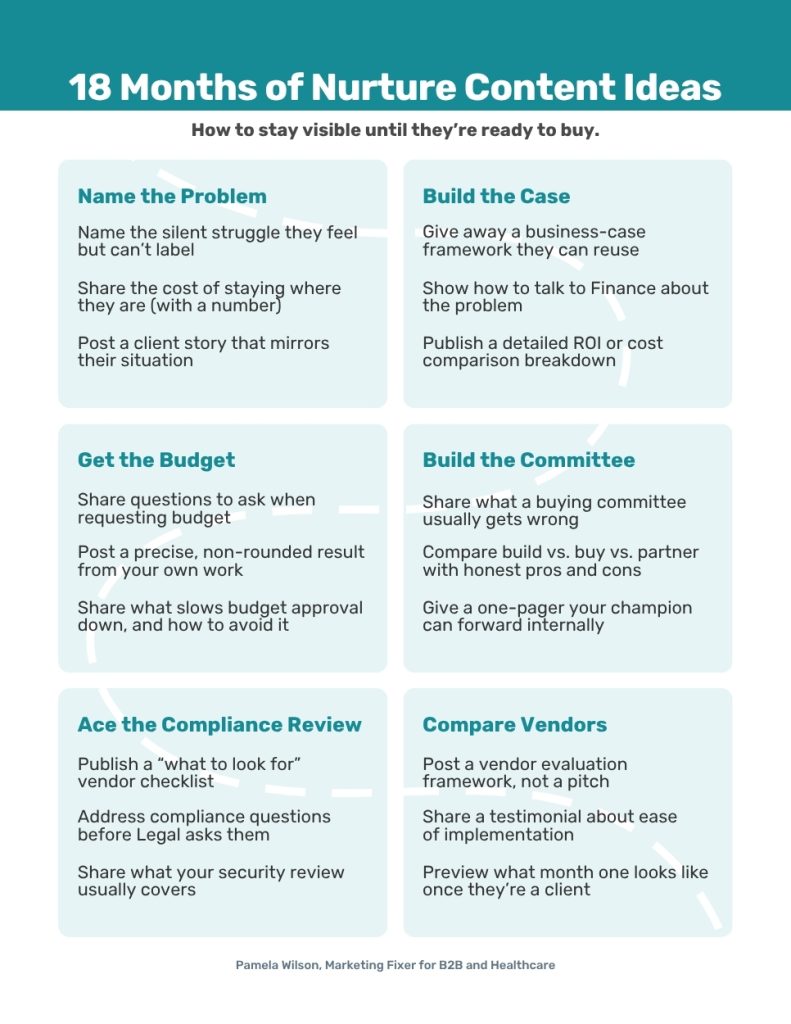
18 ways to nurture leads, organized by buying stage
Name the problem
- Name the silent struggle they feel but can’t label
- Share the cost of staying where they are (with a number, if you have one)
- Post a story that mirrors their situation
Build the case
- Give away a business-case framework they can reuse
- Show how to talk to Finance about the problem
- Publish a detailed ROI or cost comparison breakdown
Get the budget
- Share questions to ask when requesting budget
- Post a precise result from your own work
- Share what slows budget approval down, and how to avoid it
Build the committee
- Share what a buying committee usually gets wrong
- Compare build vs. buy vs. partner with honest pros and cons
- Give a one-pager your champion can forward internally
Ace the compliance review
- Publish a “what to look for” vendor checklist
- Address compliance questions before Legal asks them
- Share what your security review usually covers
Compare vendors
- Post a vendor evaluation framework, not a pitch
- Share a testimonial about ease of implementation
- Preview what month one looks like once they’re a client
The goal isn’t to publish all of this at once. The goal is to have content that addresses buyer questions at every stage, so you’re helpful no matter when they find you.
Building the infrastructure to nurture leads during long buying cycles
Most companies never build nurture infrastructure, which leaves the field open for those that do. Infrastructure means documented positioning, a content calendar aligned to buyer questions, and distribution across all three channels buyers use to research.
Here’s what nurture infrastructure looks like:
- Documented positioning. Your position is written down, not just understood. Everyone on your team knows what you’re known for and can explain it the same way.
- Content calendar aligned to buyer stages. You’re not publishing randomly. You’re creating content that addresses specific questions buyers have at each stage of their research.
- Distribution across channels. You’re visible where buyers look: LinkedIn for human referrals, your website for traditional search, and content optimized for AI answer engines.
- Review process. Someone checks the work before it goes out to make sure it stays on message and reinforces your position.
Building this takes time, but once it’s in place, it runs. You’re not starting from scratch every month. You’re adding to a system that keeps you visible during the long months when buyers are researching but not yet ready to buy.
When prospects finally reach out, they arrive already convinced because they’ve been following you throughout their research process.
How to patiently nurture leads over time
Extended buying cycles in B2B and healthcare mean prospects take months to decide.
Most companies treat this as a problem to solve with aggressive follow-up or quick-conversion tactics.
The companies that grow predictably build nurture infrastructure instead: clear positioning, systematic content that addresses buyer questions at each research stage, and consistent presence across all channels buyers use.
Nurture keeps you visible during the long window when buyers are forming their shortlist. When they’re ready, you’re the obvious choice because they’ve been following you the entire time.
Frequently asked questions
How long should you plan to nurture leads before prospects convert?
There’s no standard timeline because buying cycles vary by industry, deal size, and complexity. B2B software purchases might take six to twelve months. Healthcare partnerships can take eighteen months or longer. The point of nurture isn’t to speed up the timeline. It’s to stay visible throughout the timeline that already exists.
Can you nurture leads without a marketing team?
Yes. Nurture requires clear positioning and systematic content, not a large team. One expert marketing leader can create the strategy, build the AI-driven system that implements it, and review the work before it goes out. You need leadership and oversight, not a full department.
What’s the difference between lead nurture and a newsletter?
A newsletter is a tactic. Lead nurture is a strategy. Newsletters can be part of nurture, but only if they’re aligned to a clear position and address real buyer questions. Most newsletters are generic updates that don’t move prospects closer to a decision. Nurture is systematic content designed to keep you visible and credible throughout the research process.
How do you measure whether lead nurture is working?
Look at lead quality, not just lead quantity. Are prospects arriving with better questions? Do they already understand what you do? Are they mentioning content they’ve read? Are sales cycles shorter for nurtured leads than cold outreach? If prospects convert faster and close more predictably after following you for months, nurture is working.
What if we need leads now and can’t wait months for lead nurture to work?
Nurture and immediate lead generation aren’t mutually exclusive. You can run both. The difference is that immediate lead gen tactics produce short-term results but don’t build long-term visibility. Nurture builds the infrastructure that keeps qualified prospects moving toward you over time. Companies that focus only on immediate conversion leave money on the table because they’re not capturing buyers who need more time to decide.
Ready to build the strategy and lead nurture infrastructure that keeps you visible during extended buying cycles?
My four-week marketing strategy intensive creates the comprehensive strategy that makes long-cycle nurture possible. You’ll walk away with clear positioning, messaging that resonates with your ideal customer, and a roadmap for staying visible throughout the research process.
For companies ready to implement, my fractional CMO services provide ongoing marketing leadership. I build the AI-driven system that implements your strategy, reviews all marketing assets before they go out, and keep the work on plan so prospects remember you when they’re ready.
Explore both options at growthmarketing.studio/pricing.